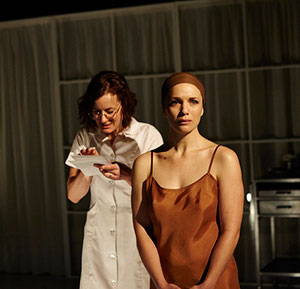
 Left – Karen Sibbing and Meredith Penman. Cover – Karen Sibbing and Daniel Schlusser. Photos – Ellis Parrinder
Persona is a brilliant piece of theatre. Despite being adapted from a film, it is one of the best explorations of the theatrical I have ever seen on stage. It explores what it means to play a role – to adopt a persona – and, perhaps more importantly, how difficult it is to stop. Pursuing truth in oneself becomes a frustratingly impossible task: are we no more than a series of roles, with no underlying coherence or unity? No self beyond the personae we have created?
The show is centred on the relationship of two women. Elisabeth (Meredith Penman) is an actress, who, in the middle of a performance of Electra, stopped speaking for a full minute. She was able to resume her performance, but the next day, silence seems to have settled on her totally. After three months in hospital, she and her nurse Alma (Karen Sibbing) go to a remote house in the countryside, in the hopes that this will promote Elisabeth’s recovery. With no one but each other for company, a kind of twisted friendship develops between the two women. Elisabeth does not speak but Alma (who claims that she is a good listener, although no one ever listens to her) finds words spilling out of her like a fountain. Their identities blur and mesh and overlap, until, at the denouement, Elisabeth’s husband (Daniel Schlusser) seems unable to tell which woman is his wife.
Persona relies heavily on the strengths of the two actresses, and director Adena Jacobs has cast her show beautifully. Meredith Penman is revelatory as Elisabeth, at once vulnerable and icy, kind and cruel, conniving and exposed. This is a largely dialogue-free role, and thus incredibly difficult, as well as placing the actress in competition with Liv Ullmann, who starred in Ingmar Bergman’s film. Penman rises to the challenge. She is simply outstanding. Similarly, Karen Sibbing’s Alma is a fascinating psychological study. She exclaims towards the end of the play that although she talks a lot, she never manages to say what she means, but Sibbing makes sense of Alma’s rambling soliloquies. We see her transform from strict professional to attempted friend to something akin to a supplicant in a confessional. The scene where Alma confesses one of her darkest secrets to Elisabeth reminded me strongly of the way Foucault theorises the confessional, as a place in which a person can transform their actions into discourse, measuring themselves against a social standard. For Alma, the beauty of having Elisabeth as her confessor is that because Elisabeth cannot speak, she can neither share Alma’s secrets nor express judgment, making Elisabeth’s ultimate betrayal that much more affecting. Sibbing handles the disintegration of Alma as her sense of self unravels with aplomb, offering a performance which is both subtle and affecting.
The one element of the show which I wasn’t a huge fan of was the beginning, where a young boy (presumably the child of Elisabeth and her husband) sits in front of the audience on a stark white stage, reading a book. While Elisabeth’s role as a mother is an important motif in the play, I don’t think actually seeing her son was necessary, and this scene did not really enhance the show in any way. It functioned in much the same way as prologues do in novels – and nine times out of ten, the prologue is something that can easily been cut.
Otherwise, this is a genuinely outstanding production. Adena Jacobs has directed an intense, taut piece of theatre: this is an adaptation between media which really, really works. It is psychologically powerful and brilliantly acted. Highly recommended.
Belvoir presents
a Fraught Outfit production
Persona
Conceived by Adena Jacobs, Dayna Morrissey & Danny Pettingill | Based on the film by Ingmar Bergman | Translation Keith Bradfield
Director Adena Jacobs
Venue: Belvoir St Theatre | 25 Belvoir St, Surry Hills, NSW
Dates: 24 July – 18 August 2013
Tickets: $65 – $45
Bookings: 02 9699 3444 | belvoir.com.au
Sydney Reviews
Persona | Belvoir
- Details
- Jodi McAlister
Most read Sydney reviews
The Lark | Hey Dowling
Noni Hazlehurst brings Rose and The Lark to colourful and compelling life in this one-woman show.
Pride & Prejudice* (*sort of) | Neil Gooding Productions & Woodward Productions
This rollicking musical take on Jane Austen’s beloved novel is a side-splitting crowd pleaser.
Heartbreak Hotel | EBKM
Heartbreak Hotel invites its audience into an intimate portrait of the universal and isolating experience of heartbreak.
Current | Sydney Dance Company
While Bonachela’s work is, as always, dreamily lovely, for me the highlights were absolutely the three commissioned choreographers: Azzam Mohamed, Jenni Large and Raghav Handa.
The Gospel According to Paul – The Second Coming | Soft Tread Productions
The Gospel According to Paul is meticulously crafted entertainment. It’s uplifting without pulling any punches.

The Gospel According to Paul is meticulously crafted entertainment. It’s uplifting without pulling any punches.

While Bonachela’s work is, as always, dreamily lovely, for me the highlights were absolutely the three commissioned choreographers: Azzam Mohamed, Jenni Large and Raghav Handa.